
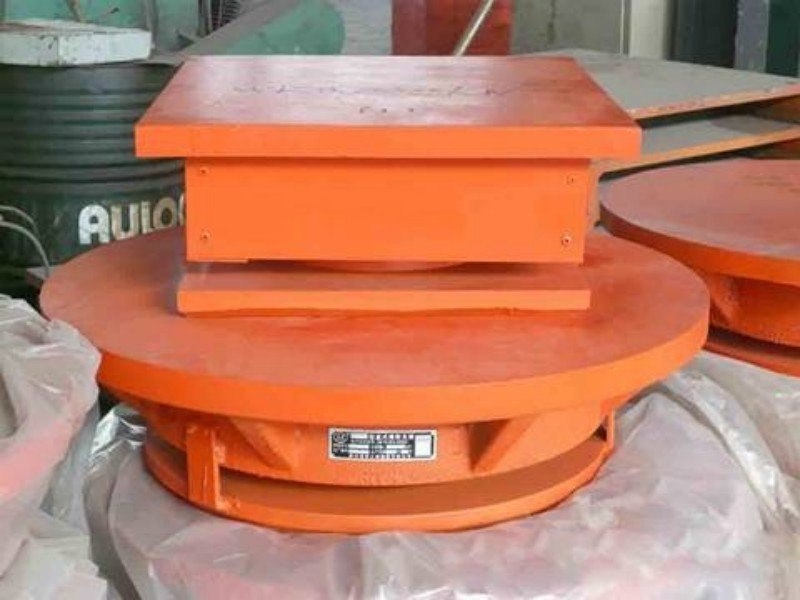
01 / Working principle
Rotation and horizontal sliding are different questions.
At its broadest, a pot bearing uses a confined elastomeric element within a steel housing to accommodate rotation while carrying the project’s vertical action through a compact support assembly. The surrounding steel parts, upper and lower interfaces, protection details and any sliding arrangement are all part of the finished bearing system. This is why a photograph or a nominal capacity alone cannot describe a complete procurement requirement.
Rotation concerns the angular relationship between the supported structure and its support. Translation concerns movement along one or more axes. A project may require both, but they are governed by different inputs. The rotation envelope should be stated with the relevant actions and geometry. The translation requirement should identify direction, total range, reversals and any irreversible movement that is expected during the construction or service life. Keeping these questions separate makes the bearing schedule clearer and reduces the risk of a guide being oriented against the intended movement path.
A fixed, guided or free description is therefore a functional starting point rather than a self-contained product specification. Fixed means the restraint intent and horizontal-action path must be defined. Guided means the permitted translation axis and the restrained axis must be shown. Free means the intended movement range, interface condition, protection and support context still need review. The structural designer’s drawings and load combinations remain the controlling documents.
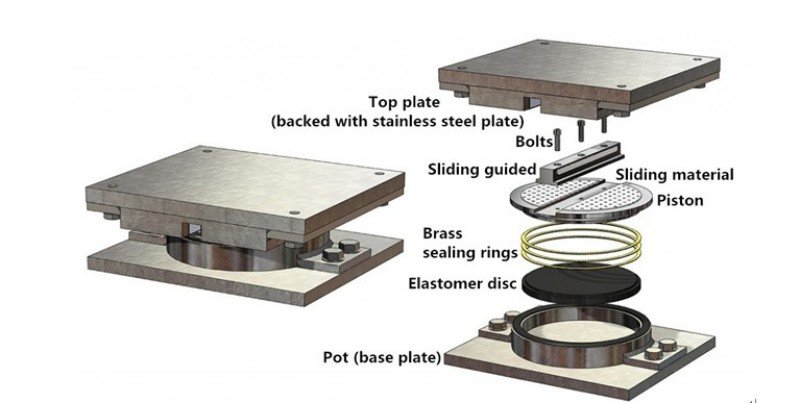
Steel pot
The steel housing provides the confined space around the elastomeric element and connects the internal mechanism to the lower support interface.
Piston
The piston transfers the design reaction into the confined element. Its relationship to the surrounding parts is governed by the selected configuration and approved product drawing.
Confined elastomeric element
When vertically compressed inside the housing, the element allows the small angular accommodation associated with the bearing mechanism. It is not a separate answer to translation or restraint.
Sliding and guide arrangement
Where translation is required, the movement surface and any guide elements must be described separately: they control direction and restraint, not simply bearing capacity.
02 / Configuration
Read fixed, guided and free in the context of the full support line.
Bearing functions are usually distributed across a bridge rather than chosen independently at each pier. The location of a fixed point, the direction of guidance and the free-movement positions should agree with the superstructure’s intended force path, expansion arrangement and construction sequence. A term such as guided is not sufficient unless the drawing also identifies the project axes and the guide direction.
For procurement, state whether the request concerns service conditions only or whether erection, launching, temporary restraint, jacking or replacement introduces another condition. Those stages can change access, clearances, support reactions, movement state or the documentation that the project team needs. The quotation route should leave room for items that are not yet known rather than encourage assumed values.
Use the drawing’s local axis convention. Fixed, guided and free are behavioural descriptions, not a substitute for the action and movement schedule.
| Function | Intended movement question | Restraint question | What the RFQ must show |
|---|---|---|---|
| Fixed | Translation is not the intended bearing movement path. | The structural horizontal-action path and any separate restraint elements must be shown. | Longitudinal and transverse actions, uplift if applicable, support interface and the position of the fixed point in the overall structure. |
| Guided | Translation is intended along the declared guide axis. | Movement perpendicular to that axis is restrained by the project configuration. | Drawing orientation, movement vector, guide direction, horizontal actions, range, reversals and clearances. |
| Free sliding | Translation may be required in the intended movement plane or axes. | The bearing arrangement does not by itself describe the whole structural restraint strategy. | Movement envelope, interface exposure, protection, support geometry, travel allowance and inspection access. |

03 / Interfaces
The bearing must fit the support detail as well as the action schedule.
The available height, plan footprint, pedestal geometry, top and bottom connection concept, anchor pattern, edge distances, elevation datum and site tolerances all affect whether an assembly can be coordinated cleanly. These details should travel with the bearing schedule. They are particularly important where a replacement has to fit an existing support or where an installation sequence gives the contractor limited access beneath the structure.
The project team should also make the boundary of the bearing supply clear. Depending on the request, the bearing body, sole or connection plates, anchors, sliding components, protective details, markings and project documents may be handled in different scopes. A useful RFQ does not assume that every visible item is included. It identifies the interface and asks the supplier to confirm the proposed supply boundary against the drawing and specification.
04 / Technical RFQ
A bearing tonnage is not a full specification.
A single vertical-load figure leaves major questions unanswered. The team still needs to know the applicable load basis and combinations, minimum and maximum reactions where relevant, horizontal actions, uplift requirement, translations in each axis, rotations, function, guide direction, environmental exposure, support geometry and required documents. The same nominal vertical reaction can lead to materially different interfaces and review requirements when the movement, restraint or connection conditions change.
When values are preliminary, send the current bearing schedule or reaction table and identify which items are still being developed. It is more useful to distinguish a known value from an unknown value than to insert a placeholder that may later be interpreted as a design instruction. Drawings, sketches, photographs of an existing support and project specifications can be uploaded with the RFQ so the technical discussion begins with the real interface.
| Item | Why it matters | Confirm in the inquiry |
|---|---|---|
| Design actions | The assembly must be reviewed against the actions and combinations that govern the project, not a nominal load alone. | Vertical and horizontal actions, uplift where relevant, load basis and applicable service, ultimate, seismic or construction-stage combinations. |
| Movement and rotation | Translation direction and angular demand affect the function, interface and drawing coordination. | Longitudinal/transverse movement, total travel, reversals, irreversible effects, rotation axes and concurrent conditions. |
| Function and orientation | Fixed, guided and free labels need a drawing-based meaning. | Bearing schedule reference, guide direction, local axes, restraint intent and the support’s place in the full bridge layout. |
| Geometry and interfaces | The bearing must fit its pedestal and superstructure interfaces. | Available footprint and height, elevations, connection/anchor concept, hole locations, clearances, tolerances and access. |
| Environment and documents | Protection, material records and release information are part of the supply discussion. | Exposure context, applicable standard/specification, coating or protection requirement, inspection/test scope and document list. |
If part of the data is not yet known
Upload the current drawing, bearing schedule, reaction table or site photos and identify the open items. The purpose of the first review is to clarify missing project inputs—not to treat an assumed value as final design data.
05 / Procurement clarity
What is included in a quotation should be visible in the quotation.
The rows below are a practical comparison framework. They do not state that every item is supplied in every project; the relevant supply boundary must be confirmed against the approved drawings, specification and commercial offer.
| Item | Why it matters | Confirm in the inquiry |
|---|---|---|
| Bearing assembly | Identifies the requested function and project-specific configuration. | Configuration, marking/position reference and design-basis assumptions. |
| Upper and lower interfaces | Connection plates or interfaces affect dimensions and coordination. | Whether they are included, their drawing status, interface load path and installation datum. |
| Anchorage or fixing items | These may be part of the bearing interface but should never be assumed. | Included items, responsibility for embedded elements, dimensions, material/protection and drawing reference. |
| Sliding and guide components | They determine movement and restraint behaviour for the requested configuration. | Movement axis, guide direction, protection/detail scope and any project-specific requirements. |
| Inspection and documents | Commercial comparison is incomplete if quality and records are not aligned. | Material records, dimensional checks, testing/witnessing, drawing package, marking, packing list and release documents. |
| Packing and identification | Delivered items must remain traceable and understandable at site. | Unit marking, package separation, lifting/handling documentation route, export packing and shipment terms. |
Why quotations differ
Compare the same project definition before comparing price.
| Item | Why it matters | Confirm in the inquiry |
|---|---|---|
| Actions and function | A change in load combination, restraint intent or movement configuration can change the bearing arrangement. | Compare quotations against the same action schedule, function and axis convention. |
| Movement, rotation and geometry | Travel, angular demand, footprint, height and connection detail affect coordination. | Use the same drawing revision and state tolerances and interface assumptions. |
| Materials and protection | Exposure and project requirements may change the documented material/protection scope. | Compare the named system, exclusions and repair/protection responsibilities. |
| Inspection and document scope | A lower price may exclude records, checks, witnesses or drawings needed by the project. | List every requested record, approval item, hold point and document revision. |
| Quantity and logistics | Pack-out, marking, delivery sequencing and transport scope depend on the order and destination. | Compare quantity, delivery basis, packing, identification and shipment responsibilities. |
06 / Release readiness
Before production, then before delivery.
Controlled product information follows the project’s own approval path. These lists make the required conversations visible; they are not an installation method or release instruction.
Before production
- Bearing identification and position reference
- Fixed, guided or free function and declared guide direction
- Action, movement and rotation schedule
- Main dimensions, interface levels and hole/anchor coordinates
- Material, protection and document requirements
- Inspection points, requested witnesses and acceptance route
Before delivery
- Unit marking matched to the bearing schedule
- Packing list and package identification matched to the delivered assemblies
- Approved document list and revision status confirmed
- Protection of relevant working surfaces and interfaces confirmed for the agreed delivery scope
- Project-specific handling, storage, restraint and installation documentation route identified before site movement
Visual evidence
Product images that answer different questions.
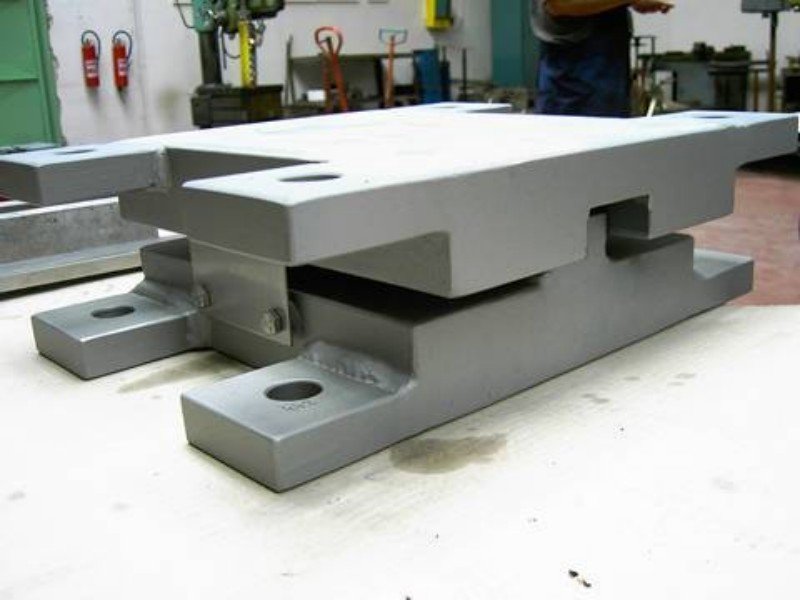
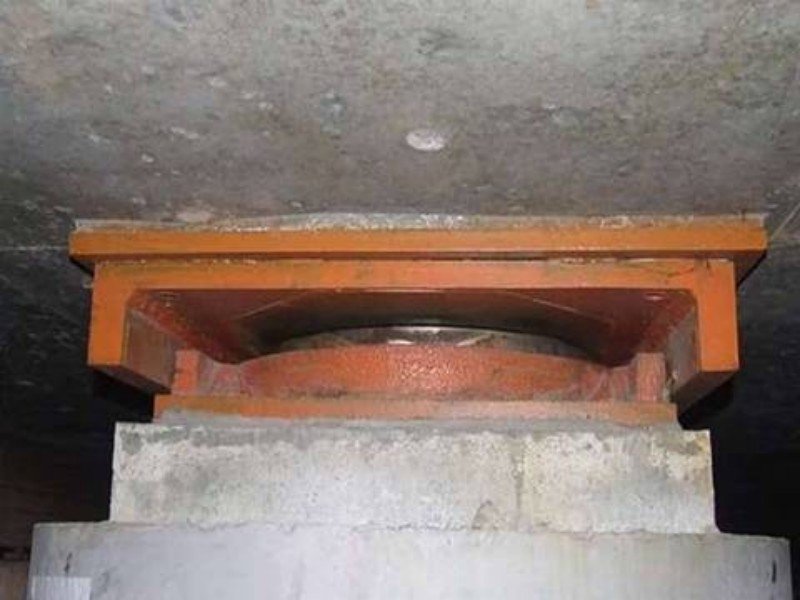
Product photographs, context images and explanatory illustrations have separate jobs. Captions state what is visible and what still needs project confirmation.
07 / Procurement FAQ
Pot Bearings: questions a customer should be able to answer before release.
Can a pot bearing be selected from vertical load only?
No. Vertical action is one input. The request also needs movement direction and range, rotations, horizontal actions, restraint function, geometry, environment, connection interface and applicable specification.
What is the difference between rotation and sliding?
Rotation is angular accommodation at the support; sliding is translation along a defined path. A project can require both, but they are described, checked and documented separately.
Why does the guide direction need to match the bearing schedule?
A guided function only has meaning relative to the project axes. A guide aligned to the wrong direction can conflict with the intended movement path, so the local orientation must be shown on the drawing.
Do connection plates and anchors come with every quotation?
They should be confirmed, not assumed. The RFQ should identify the required supply boundary and the drawing/interface information needed to state inclusion or exclusion clearly.
What documents should accompany an RFQ?
The most useful starting set is the bearing schedule, reaction and movement information, support drawing, project specification, expected quality/document scope and any construction-stage or delivery constraints.
What should be prepared before delivery?
Confirm identification, drawing revision, supply scope, packing/marking, agreed documents and the project-specific route for handling, storage, restraints and installation readiness.